Friday, November 10, 2006

Daily Life


From when I got here at the end of April until recently there was pretty much a pattern to life here. Things changed, like who was here, and what we were working on but there was a general similarity week to week.

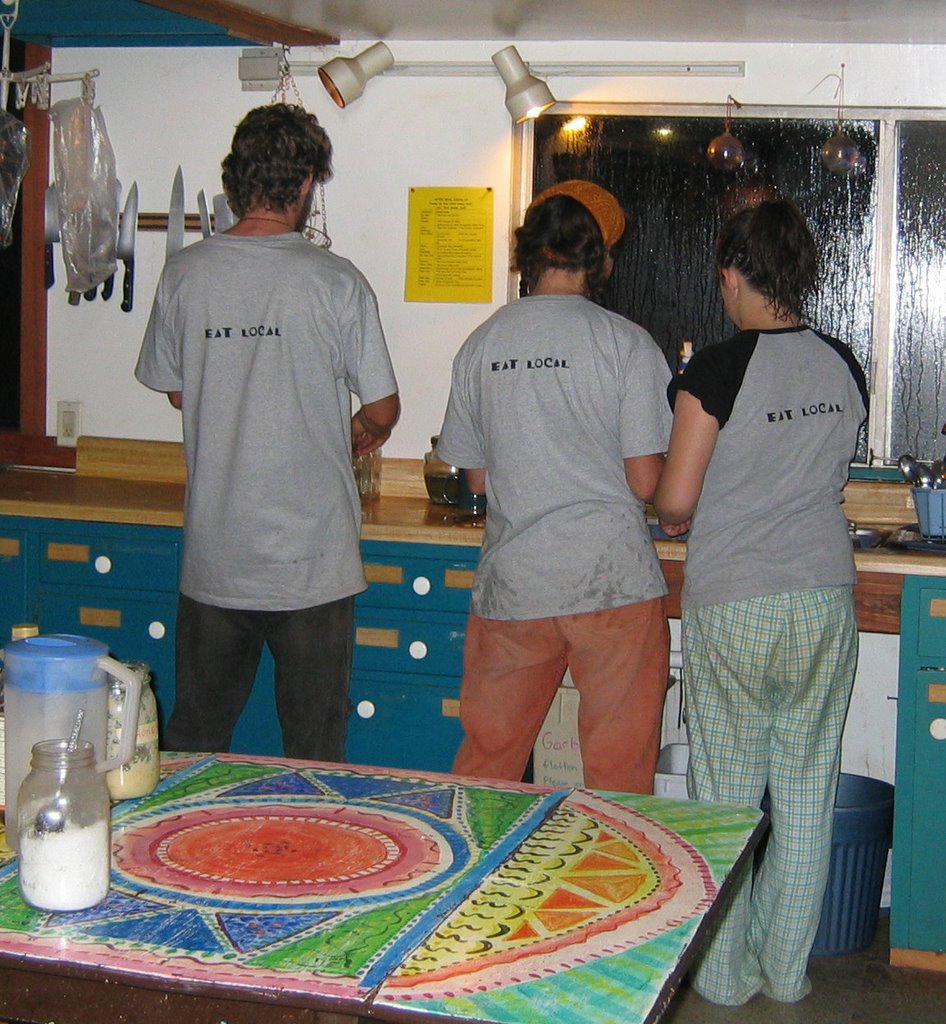
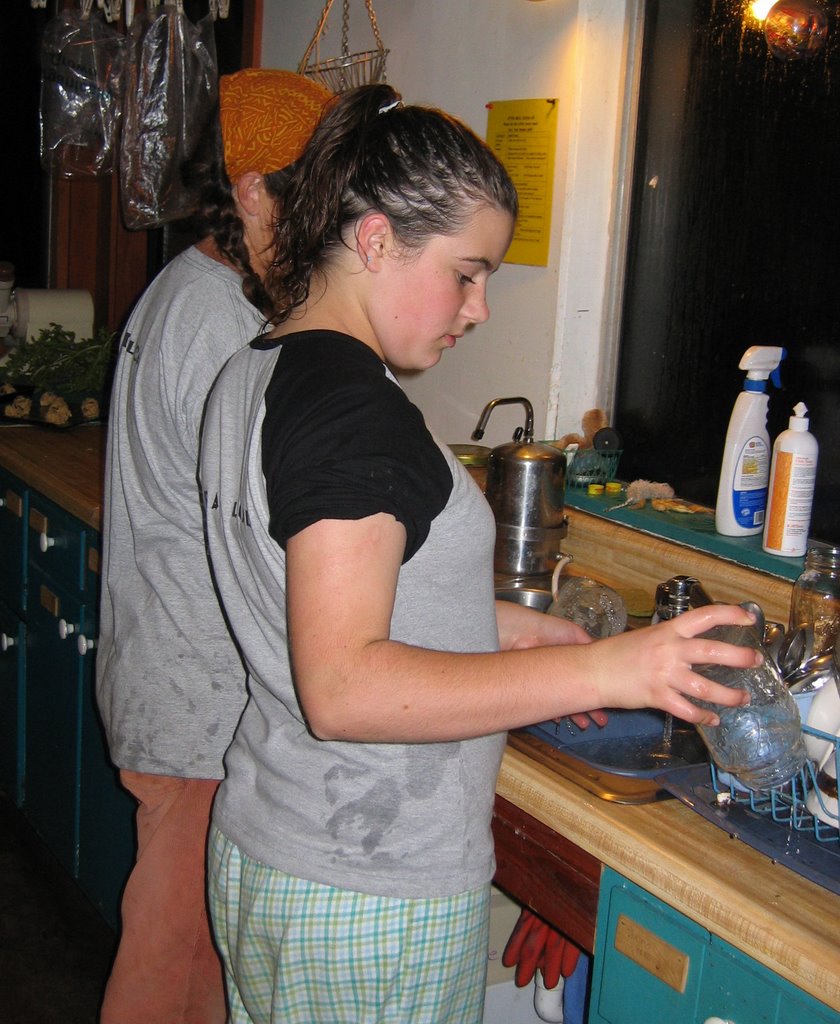
We had communal lunches and dinners everyday, and mostly made breakfasts for ourselves. People signed up for as many cooking or cleaning shifts as were needed to cover all the slots, normally 2 or 3 per week, until our population diminished. It was great to get 14 wonderfully cooked meals a week and only have to prepare one or two, and/or clean once or twice. When we had lots of people two people cleaned after dinner together to do a thorough job. Mostly cooking was done solo, although certain people liked to team up and help each other out. Lunches were at 12:30 and dinner at 7, although that changed at about fall equinox to 6:30.

Monday was meeting day, we would meet either in the morning or right after lunch (during the middle of the summer it was after lunch since often it was hot enough folks didn't want to work mid day). In the meeting general business was discussed, and the week's work was planned. Sometimes there were small tasks people volunteered to take on sometime during the week, often larger group projects were planned, or someone agreed to make sure something got done. There were also evening sharing meetings on Mondays, half the time they were just for members, the other half everyone around for any length of time attended. They were not business related at all but about updating each other about what was happening in our lives. The format changed sometimes but normally we started with appreciations, people said things they had been appreciating lately, people, chores getting done, sunsets, etc. Then there were pet peeves - small complaints about whatever had been bothering folks recently. After that we took turns telling everyone what was up for as long as it took, often not that long. The meetings only lasted about 2 hours, sometimes less.

For much of the summer work traders worked together with at least one community member, in the gardens Tuesday and Thursday mornings, and building Wednesday and Friday mornings every week. The afternoons were either free or scheduled at the weekly meeting. While the apprenticeship was going on work traders didn't build as much, only working at Strawberry house on Wednesday afternoons while the apprentices were in a lecture. And much of the fall we worked at Strawberry house every Friday afternoon too. We rarely had scheduled work on weekends, except during work parties and workshops. Each work trader had a focus, such as the shady garden, the sunny garden, or Strawberry house, where they worked their extra hours and helped lead other folks during scheduled work times. After the apprenticeship when 3 former apprentices were doing work trade they were more focused on building and didn't spend all the scheduled garden time gardening. Often we started work at 9 am, but when it was hot we started about 7 and ended early. Afternoon work usually started between 2 and 3pm. This all sounds much more strict than it really was.

Most of the members here worked at least some in town each week, and a few work traders also did some paid work off site. On weekends people often left and went to town, or the coast, or somewhere to enjoy themselves. But I almost never left, less than 20 times all summer, and it feels like even less, both to me and the others who have been here all summer.

When worktraders left (there were 11 of us this summer, I think) we usually had an appreciation circle for them. Everyone took turns telling the person leaving things they appreciated about them, work they did well, habits folks liked, things that they did that were inspiring, etc. Appreciation circles are also held on the birthdays of members. They seem nice, although I have not had one yet.

In the last week or two there has been a different pattern, with so many fewer people here, Emerald Earth is in winter mode now. We are only scheduling dinner cooking 5 nights a week and there are no scheduled lunches, but we normally eat around the same time and help each other out, heating up extra food for those who want it. We are now only meeting once every other week. And mostly instead of scheduled work people take on certain tasks and do them when they want. Although in the past week we have had two group clean up days, one of which included moving heavy things under cover, much better done in a group, but they have mostly been more informal and not planned so far in advance. We have also shown up in the garden at the same time on these beautiful sunny days we had earlier in the week. I have been noticing how slow tasks go when I work alone, all those months working in groups spoiled me.

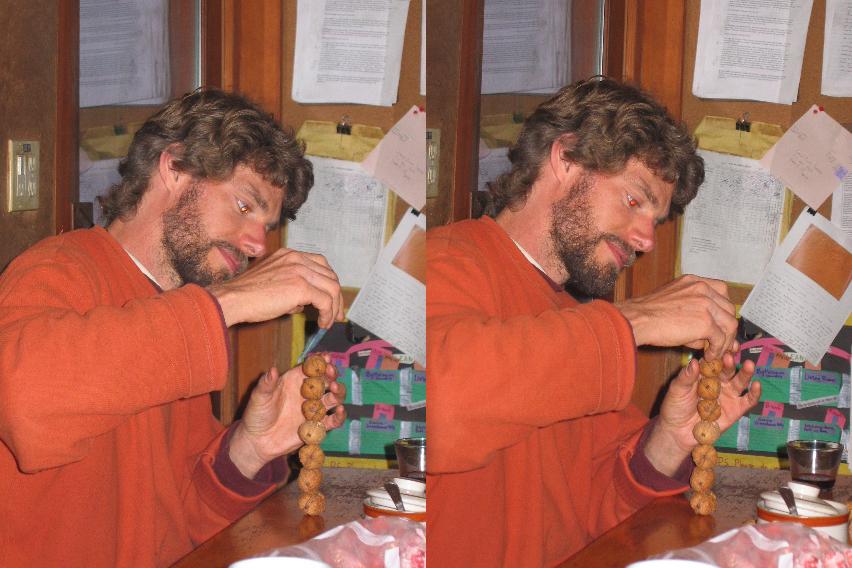
Again I am focusing on work and not play, but there was play too, normally unscheduled, games after dinner, lots and lots of backgammon, Anastasia is a backgammon queen, all terrain bocce ball, occasionally movies, saunas, pizza parties, and tons of interesting conversations, and no doubt there is lots I have forgotten. Lately the winter sport of walnut stacking has been popular. Michael holds the record from last year with 9, this year so far he has only achieved 7, and the rest of us have a hard time going over 5.
Nature's Beauty


Thursday, November 09, 2006

Musings On Roofs


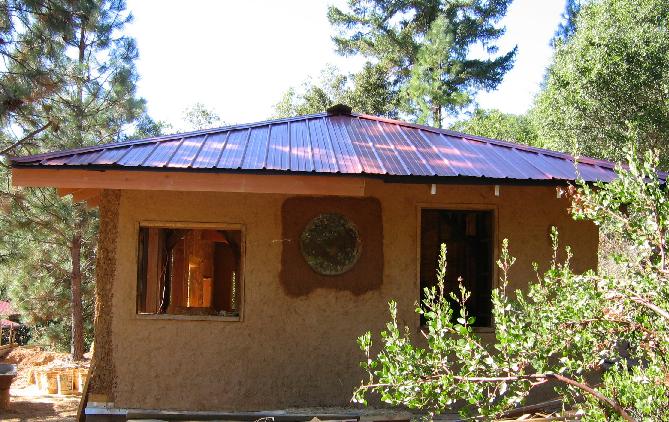
I spent a lot of time on roofs in the past few months, not so much in the past few weeks though. I like being up on roofs a lot, the height and the view I guess. I helped with 5 roofs 4 of them very different from each other. I helped some with the Madrone house roof, mostly over the second bedroom, last year it had plastic over part of it, this year we finished the walls and then put on the rest of the roof, it has a metal roof attached to perlins, thin pieces of wood running between the rafters to screw the roofing to, no plywood or tar paper or anything.


The pump house roof was fun, I really like working with shakes, although figuring out which one will fit well each time you put one up is slow work, it is fun, like a puzzle, and normally there are a bunch that would work, so it really isn't that hard. The hard part about shake roofs is finding wood that is straight enough grained to make shakes with in the first place, it needs to be old growth. Luckily here there are some stumps from old growth trees cut down a long time ago, before chainsaws when they used huge saws which had one person at either end pulling back and forth, and they wanted to cut up higher where the tree was a bit narrower. The pump house roof is not a traditional shake roof, to shed water shake roofs need to be quite steep, and this one is not, so it has very thin plywood with tar paper and sand impregnated roofing on top of it under the shakes. The shakes make it look nicer and will lengthen the life of the roofing under them.


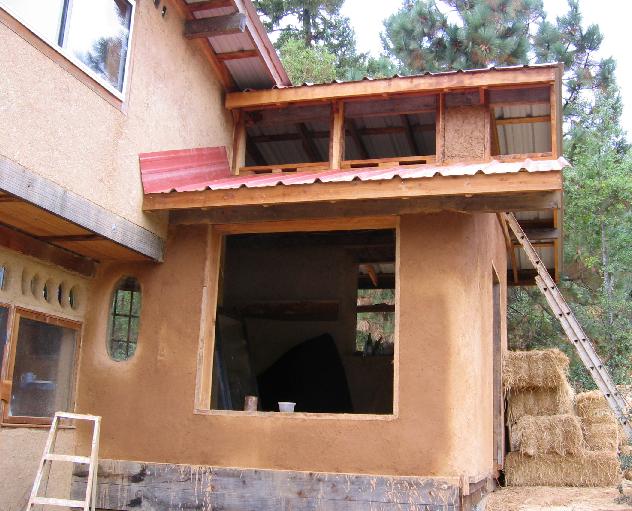
I also worked on Strawberry house's roof which is the most conventional with plywood, tar paper and metal roofing. I have written a bunch about it already so if you want to know more go back and look at older posts. But as you can see in the picture the roofing is up, including the roof caps, which were not up during the first rain, and there is even a window in.


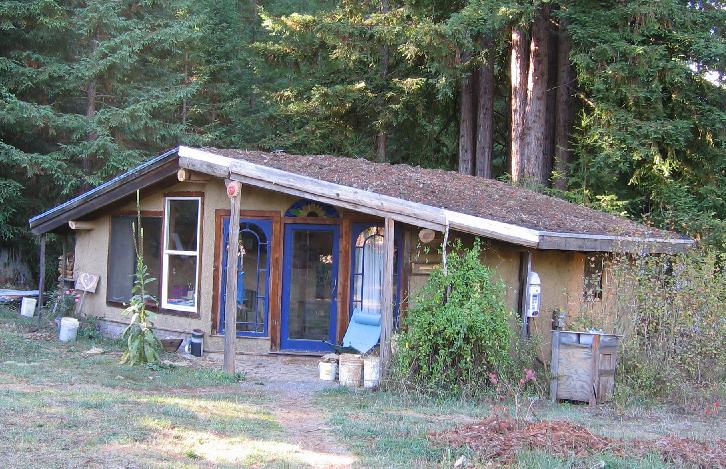
Then, of course, there is the El Nido roof, with it's pond liner and dirt, and soon to be plants, there are already plants sprouting on it. (See previous post for details.)


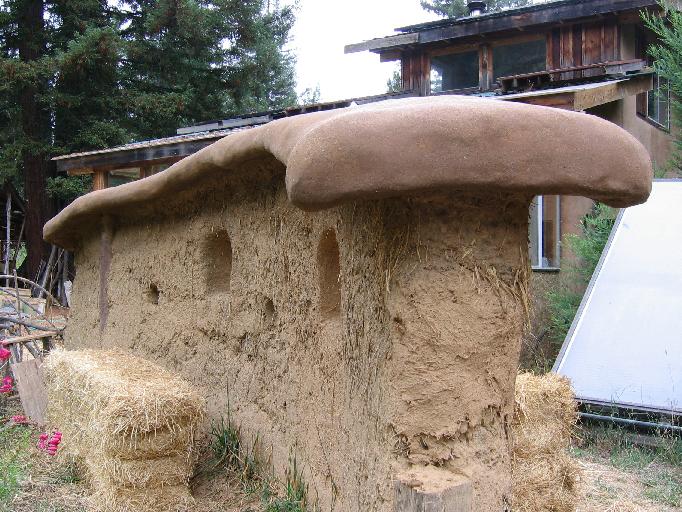
The most novel roof I worked on is the roof over the garden wall. It is an experiment and is cob, (clay soil, sand and straw) on and between small redwood branches and looks mushroom like. The cob was plastered and a drip edge was sculpted to make water drip to the ground at the edge of it instead of running around the edge and under the roof, then a final coat of plaster was put on and after that dried 4 coats of linseed oil were applied. It is cool, I hope it works.

All these different types of roofs have their pluses and minuses and which ones to use depend many things: how much embodied energy (energy it took to extract the resources and manufacture the material and deliver them to where they are used) do the materials have; how long will they last without leaking; how easy are they to replace when they do wear out; how available is the material; how steep do you want your roof; is it important how toxic or nontoxic the roof is; what do you think looks the best; what disturbs the house site least; do you care how visible your house is from above; does it matter if it is hard to get lots of insulation into it; does it matter if the roof helps the house stay cool in the summer; do you want to be able to hang out on the roof; are you interested in rain water collection; is being fireproof important; does it matter how heavy the roof is; etc.

I do not have a favorite, it would depend on the circumstances. I like the living roofs, although I didn't like working with the liner very much, and it did smell bad for you, although once it is covered that goes away. I also like how nice it is to be on, being dirt and not very steep it could be a useful area for living. And it is relatively fire proof. I also really liked the shakes, but finding bits of already dead old growth redwood or cedar is getting harder. Also I have heard they are more likely to leak, at least in the first few rains after a dry period since the wood does shrink and swell with moisture. And you can't walk on a shake roof, you can easily break the shakes that way, another drawback is it is not at all firesafe. Metal is easy and relatively long lasting and leak proof but does have a lot of embodied energy. And the experimental cob roof is not likely to be useful for using on whole buildings. I have been thinking about experimenting with an aluminium soda/beer can roof. Cutting the tops and bottoms off cans and a slit though the resulting tube, then crimping them together edge to edge to make a roll, and laying the roll out in stripes overlaping the one below, with the crimps running up and down. Maybe not for a large structure or a house but to cover a small shed, or the roof over a cob oven.

When asked which type of roof they like both Darryl and Michael say they don't like roofs, Darryl likes the way houses look with just rafters, Michael likes the openness and light in roofless houses (at least that is my impression of their reason). I can relate and think I would want some outdoor enclosed space included in/around a house I built, but I would put a roof of some sort over the house part of the house, and they did too.

Fixing the El Nido Roof


We finished this quite a while ago, before it rained, except for a last bit of dirt to go back on, but I didn't get around to writing about it then.

El Nido was one of the first houses build here and they were used a liner to go under the dirt on the living roof that was not really appropriate for that use. It leaked last winter and they decided to put redo it with a new liner, and take out some of the skylights. Originally the house had 3 skylights, and skylights are notorious for causing roofs to leak. The one in the bedroom which was really needed was replaced, the other two were taking out and replaced with wood, even from inside looking up it is hard to see where they used to be.

First the dirt was taken off and piled up behind the house to be put back after we were done. Then the skylights were taken out. Then, since the old liner was stuck on old used carpets were laid on top of the old liner. The carpets had been stored outside so they were swept off well since any little sharp bits could poke a hole in the new liner and create a leak. After that the new pond liner was put in place. It is really heavy and it took quite a few of us to get it on the roof and unroll it. That roof has thick sheets of insulation on top of it where the house is but not over the eves, so the roof is not smooth, which made it hard to get the liner to fit well. We didn't want to stretch too tight anywhere since that seems more vulnerable to punctures and it is hard to get to stay where you put it. The liner is like a tire inner tube, it reminded me a lot of new bicycle inner tubes in texture and smell. Not a terribly natural material, but not likely to leak. Once people were satisfied with how the liner lay, we attached it by putting flashing around the edges. And the skylight and hole for the stove pipe had to be cut and very carefully sealed. Then we cut the excess liner off the edge of the roof, and put the drains in, the roof drains from the corners but inside the edge of the roof, not in gutters around it.

Once the liner was on we put some rock around the bottom of it to help with drainage. Then it was time to lift all that dirt back onto the roof. Luckily we had a lot of help with this. A few people would work on the ground shoveling dirt into 5 gallon buckets, then someone would lift them up to someone on the roof who would heave them up and take them to where they needed to be dumped. There were usually two people on the roof too so we didn't get behind. I was one of the lifters and dumpers on the roof. Living roofs are normally not very steep since the dirt can roll off if they are so being on it was easy, and this one was pretty low to the ground too so lifting buckets up was not a huge problem.

It was all somewhat more complicated than I make it sound, especially making the skylight and stove pipe not leak, but it seems to be working, no leaks in the last few rains.

Cute Kids


We have had an number of awfully cute young children visit recently, some of whom I have gotten photos of. Right now at Emerald Earth the only child is Aria, and she is not a little kid any more, but very soon Brent and Liz are going to have a baby (due in a week or so) then there will be a very young child around. And a couple with a one year old child is planning on staying for 8 months or so, starting late winter.

Wednesday, November 08, 2006

Douglas the Squirrel


As I mentioned in a previous post, there is this small squirrel who spends lots of time in the pine tree in front of strawberry house. We named him/her (we do refer to Douglas as he so although I do not know his sex I will stick to that from here on out) Douglas since we were told he is a Douglas Squirrel. He has a voratious appetite, or at least is storing up a lot of pinenuts. Douglas chews all the scales off pinecones to get to the pinenuts between them, then drops the cores of the cones. Anastasia got into collecting the pinecone cores and counting them to see how much he had eaten/stored. Before she left last week she had found almost 500! At one point she found a stash of uneaten pinecones, about 50 of them, which he quickly ate through after she found them, presumably afraid she would steal them.

We are quite sure there is just one squirrel, we only every see one and he seems quite tame, willing to be around people, even people with power tools. Although he does like to drop things on people, or try to, or into wheelbarrows people are using. And the week we were cutting metal roofing with a skill saw he was not around much, it made an awful noise, like a metal animal in it's death throws. Normally he is in the pine tree chewing away, but I have seen him in the mudpit drinking, and even in the house climbing on the walls and on a windowsill. He also makes interesting sounds, almost like he is trying to imitate us, or the power tools.

Tuesday, November 07, 2006

Art Food - Food Art, & Abundance


Food can be so beautiful. Some fresh veggies have amazing colors shapes, and patterns, and of course food can be assembled into beautiful creations, like that flower covered chocolate birthday cake.

Sometimes just a particular vegetable is extra special, like that cool tomato, and sometimes you just need to look closely, like the zucchini, or chard.


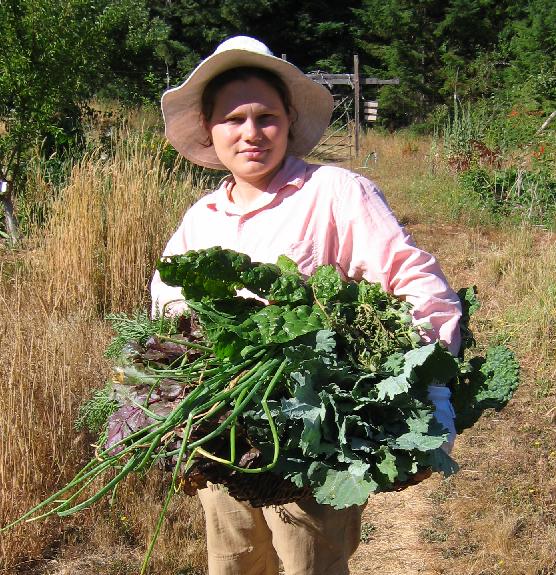
We are still getting quite a bit of food from the garden.

That is only a small portion of the peppers we have right now, we picked them all off the plants so won't get anymore but we have 3 boxes of them, two of spicy peppers which are going to be pickled, and one of peppers for stuffing. We had a very warm and sunny October, which made the peppers, and strawberries, happy.

The bowl of strawberries on the gardenshed table in the picture I picked today, yes we still have lots of strawberries even in November. And last week Sara made a bunch of jars of strawberry jam from the berries we picked then.

A week or two ago after I picked all the basil I took off all the good leaves and had a huge bowl, really a huge bowl (it is sitting on a regular sized wooden picnic bench and is a lot wider) of basil, then made pesto.

An Ode to the Moon


Sculpture and Artistic Touches


A lot of natural building materials can be used to make beautiful sculptures as part of buildings. I have taken photos of some of the ones here. Some are done and painted, some just made with rough plaster and will get finished later; some are large, some small; some inside, some outside; some detailed, some simple; some are useful, most purely art, all are beautiful.

I also added a picture of the fresco on the front of fern cottage, frescos are made with lime plaster and lime wash and a lot of burnishing. And a picture of the tile mosaic in the shower.

Friday, November 03, 2006

Fall Birds


I have been hearing geese overhead flying south. Michael said he saw two large, beautiful V's of them flying over recently, but I have just heard them.

There are lots of little birds eating seeds. I often scare flocks of quail when I walk out my door, and this morning I saw a bunch of little hoppy birds out the window. I counted 34 just out one window, well two windows right next to each other, and there were lots more out there. There was also a gang of blue jays.

The other day in the garden I saw what I think were robins, they were in one of the beds that had had grain growing in it, maybe some had fallen to the ground or maybe they were just eating wild grass seed.

Thursday, November 02, 2006

Rain Today


It rained most of the day. I mainly stayed inside by the fire, drank tea, read, wrote, painted, and talked to my brother who came over for a visit. It was a nice relaxing day. I am fond of rain and we were ready for it so there was no last minute covering of things.

Parts of the madrone house roof still don't have gutters so the rain splashed off the roof on to the ground below, making mud puddles, and nice splashing sounds.

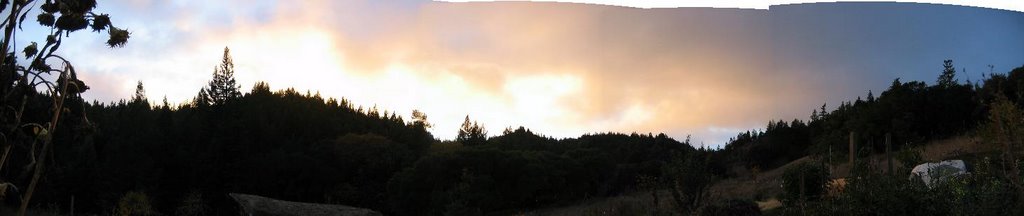
In the afternoon the rain started to lift and before sunset the sun was out, and there were pretty puffy white clouds.

There are so few people around these days we are each making our own lunches, up until now there have been communal lunches and dinners each day with people taking turns cooking and cleaning. I cooked a curried lentil quinoa soup with chard on my rocket stove, the barrel you can cook on doesn't get really hot but since I put in on the stove really early it was cooked in time. The bench that the flew goes through got quite toasty, even a little uncomfortably hot to sit on for long periods.


I realized that in an attempt to not upload too many fall colors pictures for the last post I had missed a lot of the different colors, the red and orange trees in particular, so I am adding one now.

Thursday, October 26, 2006

Frosty Nights and Fall Colors


The night before last was the first real frost, last week there was a bit of frost in places, and last month there was also a bit of frost one night, enough to kill the plants in one of the squash beds. That was an unusually early frost. Emerald Earth is in a frost pocket, at least parts of it are.

Since we thought it might frost we prepared, picked all the winter squash left, and the basil. There were some huge basil plants, the largest one being the one I am holding in the picture, yes that is only one plant. We also harvested all the peppers off some plants and covered the rest and the tomatoes, to keep them a bit warmer. It worked they survived. We finished right before dinner and didn't have time to put the squash away until late so Anastasia and I each pushed a wheel barrow full of squash down and into the house she is staying in, she put a flashlight into the squash at the top of the load to have a headlight so we could see since it was already quite dark. It was all quite funny.

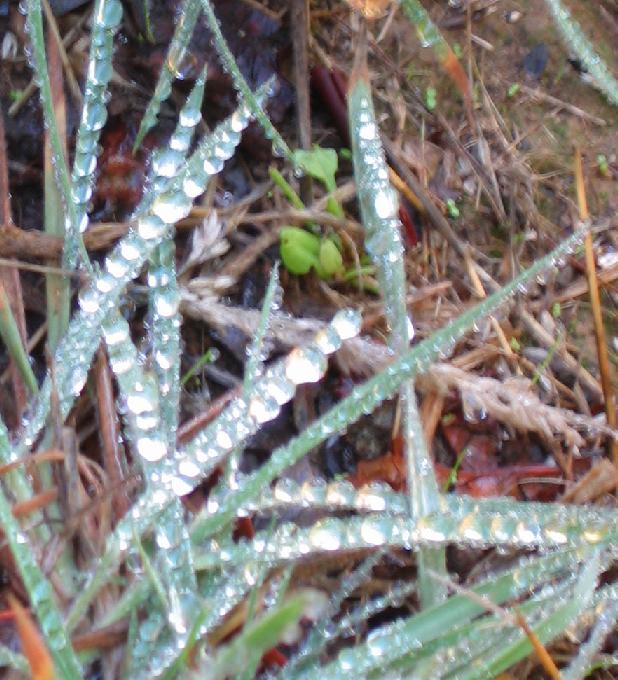
It is hard to get good pictures of frost, to capture the sparkles, but I did my best. It was very beautiful, the picture of the bridge is from last week, the rest from yesterday morning.

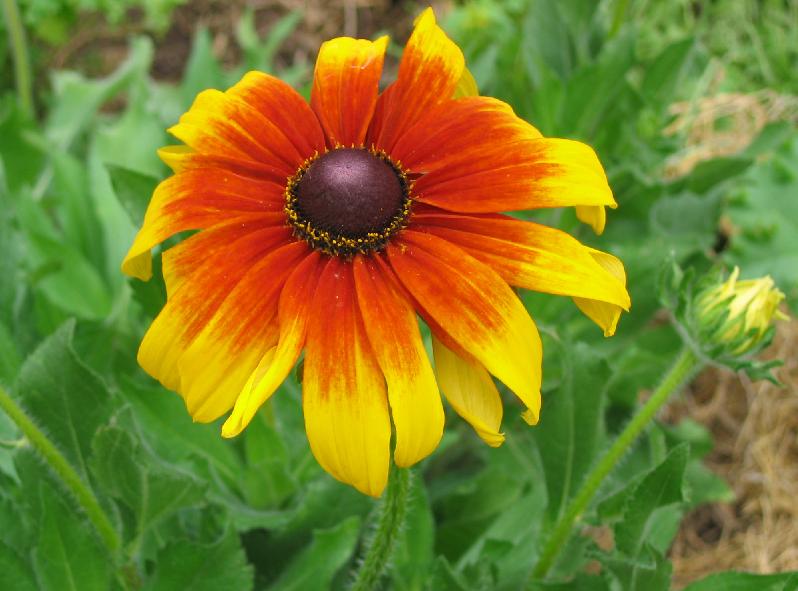
As for fall colors, there quite a few wild plants turning colors, oregon ash, poison oak, maple, some oaks, and a variety of fruit trees too, the pears are turning a really nice red, the apples yellow, some of the grapes waiting on pots to be planted into a half finished trellis have bright red leaves. I know Eastcoasters don't think of California as having fall colors, and we don't as much, you need to look and pay attention, you don't get hit in the head with them.

Saturday, October 14, 2006

Light Through Colored Bottles


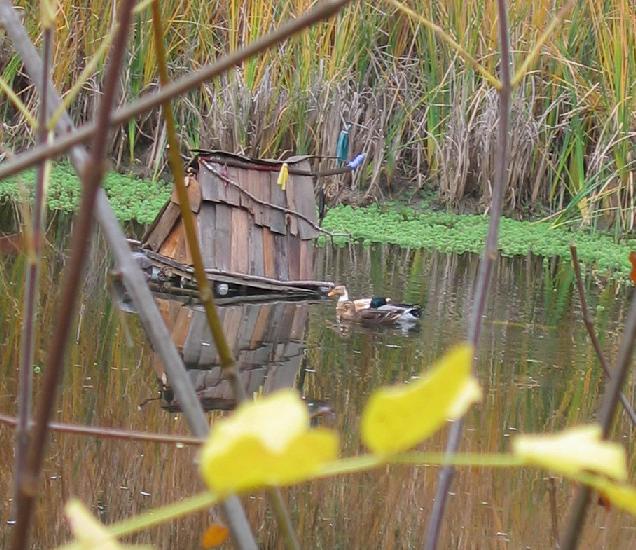
There are lots of bottles in the walls at madrone house, blue and green in the east and west walls, and red in the south wall and one red vase in the north wall too. The bottom picture is moonlight, the rest sunlight. It is nice both seeing the bottles glow and the colored light shining through them into the house.

Rocket Stove


Madrone house has a rocket stove, it is a special kind of wood stove, not a regular metal box stove, nor a fire place. It is way more efficient and heats the bench as well as the air in the room so it stays warm longer, plus you can sit on a warm bench.

The way it works is air is drawn in through the top of the barrel used to put the wood in, the fire is in that barrel and in the tunnel between it and the larger barrel, then the heat rises up inside the larger barrel which has two layers with insulation around the middle one to keep the gases very hot which makes the stove draw air in better and makes the burn cleaner, then the hot air goes down between the outside of the inner tube and the barrel then out a pipe running through the bench then up the stove pipe out of the house. We ran it once, it has been pretty warm, Michael who had a stove like this in the past helped me start it, it is quite fussy. When we went out to see what was coming out the stove pipe you couldn't really see anything, no smoke, which means it was burning very well and cleanly. Not only does it burn very efficiently and cleanly it keeps the heat inside the house, most stoves need to let lots of heat out up the chimney to make the stove draw air in and burn well, the rocket stove uses the heat riser inside the large barrel to do that instead. Since it heats the bench which has a high thermal mass so keeps the heat for a while, you can keep a room warm for a lot longer then the stove it running. Also the clay and sand mass around the barrel gets warm and radiates heat into the room, and the barrel gets hot enough to heat water or cook on.

It is really strange, you expect smoke to rise from a fire but although the top of the small barrel surrounding the fire was open no smoke went into the room, and the flames burned sideways, towards the channel going into the other barrel and the heat riser, not up. For more information on Rocket Stoves check out www.rocketstoves.com

October Work Party - Part Two - Building


We did a lot of building at the work party, worked on 5 projects, I think.

On the pumphouse we worked on the shake roof. To make everything fit together the shakes need to more or less rectangular, not curved, so any curved parts need to be cut off before they are put up. The way a shake roof works is using lots of overlap. The bottom row is shorter than the rest and the second row over laps it completely, with the seams staggered. You nail two nails into each shake at the top so the next row will cover the holes. You need to carefully position the shakes to cover both the nails and the seam between the shakes below. Since we split blocks of wood of different widths the shakes are different widths, the wood we split the shakes from were all the same length though, so the shakes are about the same length, which is nice. You want the tops of each row to be even straight lines, unless you want to make patterns. You need to leave a gap between a shake and the ones to the left and right of it so they will have room to expand when they get wet.

We also did finish plastering on the pumphouse, the wave pattern is tough especially for beginners, much harder than simple straight surfaces, since you want it really smooth and need to worry about all the edges.

Some of the group worked on putting dirt back on the El Nido roof, I will write more about the whole roof fixing project later.

Most of the rest of the building during the work party was plastering, we did a lot of plastering at strawberry house, the east and west walls on the outside, and some of the north wall. After the plain plaster was put up Liz did some sculpture on the west wall.

Monday morning half the group worked on putting finish plaster up on the roof of the garden wall, now it is ready for the linseed oil to protect it from water. It is an experimental roof made of cob with redwood branches put across it then cobbed over to make the overhang. The wall needs a roof to protect it from rain, otherwise it slowly erodes.

On Monday we also plastered the outside of the second bedroom at madrone house, the rest of the house is pretty much done but that room has been sitting unfinished. We wanted to get the first coat of plaster on the outside of the light straw clay and the strawbale walls before it got rainy since it protects the straw from moisture.